
Popular Aquascaping Styles & How AquaBed Supports Them
Aquascaping and planted aquariums have gained real popularity in the last few years, as folks are increasingly seeking natural beauty and finding ways to bring the outdoors inside. If that’s your goal, you really can’t do much better than one of the many popular forms of aquascaping. Each style has its own set of ideas, guidelines, and governing principles, and more often than not, AquaBed is an ideal addition to help designers of planted aquariums to achieve their design goals. Here we will dive a little deeper into five of the more common styles, and share how AquaBed can help to make your aquascaping dream a reality.
Aquascaping Styles
Much like painting, drawing, or other artistic expressions, aquascaping allows designers to play with form, scale, color and perspective to achieve scenes that can range from hyper realistic to abstract. By working within the standards of each style, aquascape designers can create impressive indoor water gardens in their planted aquariums. Here are some of the most common styles to choose from:
Biotope
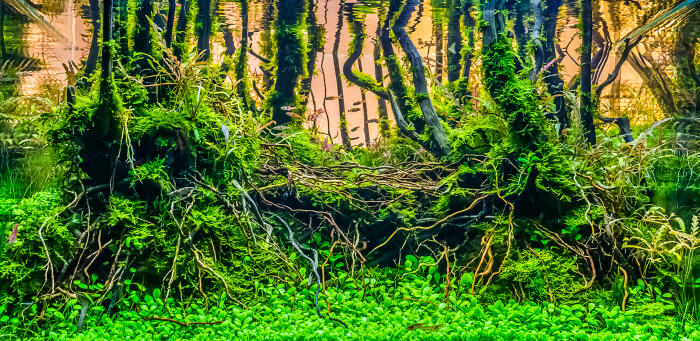
Biotope aquascapes are the most naturalistic option if you want to follow a specific style. They aim to replicate a unique, natural aquatic habitat, with a focus on hyper realism. From South American blackwater rivers to African lakes and Asian streams, biotope aquascaping is all about the details that make a place uniquely suited to its place and the animals that call it home. Designers aim to recreate exact, native water parameters as well as realistic substrate and surroundings.
Because biotope aquascapes are so true to nature, some may find them to be a bit chaotic or wild, but that’s not a bad thing–that only means that the designer has succeeded. Common substrate choices include sand, mud, and gravel, making this aquascaping style compatible with AquaBed planting pouches. The self-contained nutrient-rich growing medium requires a topper to stay in place, and it does not affect the quality or character of the water in a planted aquarium. Plants grow strongly and can remain well-fed for long periods of time.
Iwagumi
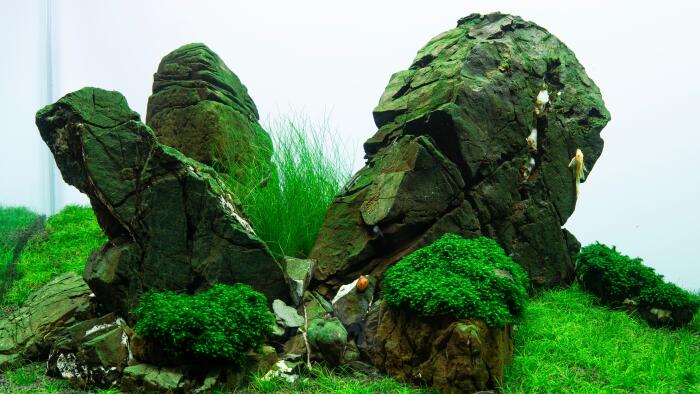
Derived from the Japanese term for “rock formation,” this aquascaping style is truly all about the rocks. Iwagumi planted aquariums are minimal and focus on harmony and simplicity. They reflect various elements of Japanese culture and can have an imbued sense of spirituality. When combined in various ways, the rocks used in iwagumi aquascaping can resemble natural mountain ranges or serene, open plains, punctuated by boulders. Oftentimes three stones are used together, but this is not always the case.
Small, schooling fish and low-laying carpet plants are typically used to dress the set and accentuate the rocks’ size and structure. Taken together, the various elements of iwagumi aquascapes truly set a scene. Plants can be planted into the substrate that surrounds the feature rock formations. At a low profile and small size, AquaBed planting pouches could help aquascapers to grow healthy, vibrant, and robust plants with minimal effort.
Dutch
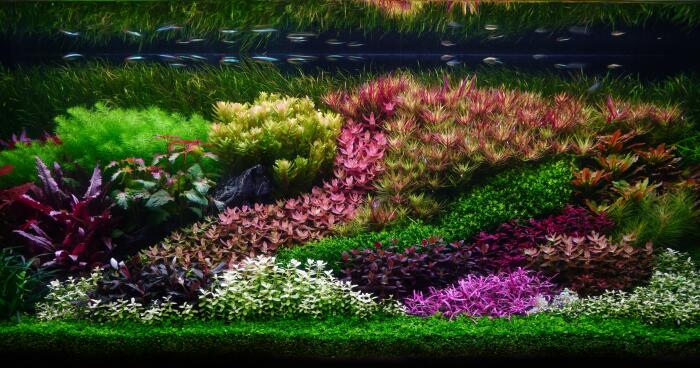
Not new by any means, the Dutch aquascaping style originated in the 1930s, but remains a popular option. This planted aquarium is truly an underwater garden, with no hardscaping and a sole focus on the plants. Lush and overflowing is the goal, with a built-in sense of order coming from the characteristic terraced design. A successful Dutch aquascape has a distinct sense of depth and perspective.
Plants are selected for details that will bring contrast and texture to the overall scene. They are often pruned and shaped to create a very highly controlled aesthetic. To keep plants looking their best, they demand intense lighting and rich growing substrates. Even if aquascape designers do not stick to the protocol precisely, deliberate and thoughtful substrate selections allow for a lower maintenance planted aquarium that will still provide an impressive display. AquaBed aquarium planting pouches disappear below the substrate and can support two to three plants, densely planted, for years at a time. Plants will grow strong and lush, and provide the striking visual desired. Paired with shoaling fish, the Dutch style makes for quite the planted aquarium.
Pond
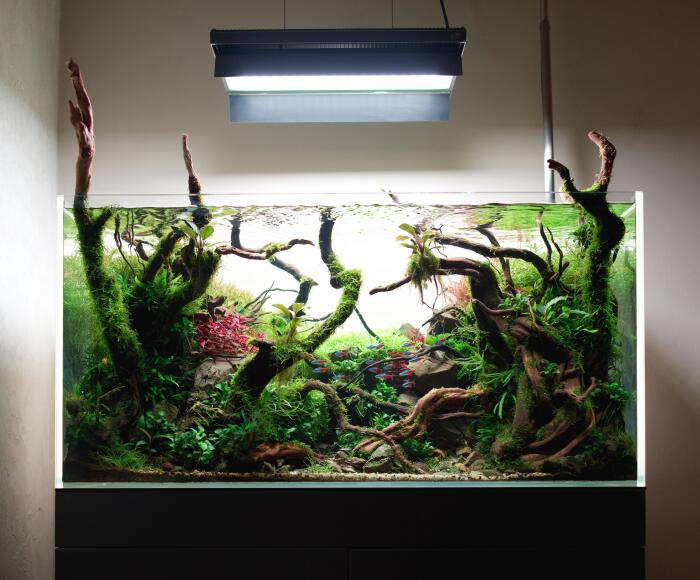
Pond-style aquariums add another dimension to existing techniques and designs. Actually known by the term “paludarium,” pond-style planted aquariums feature a new perspective, with both submerged and emergent plants taking center stage. This style also incorporates exposed hardscaping and shallow water views. Sloped substrates give dimension and lend themselves to a natural variance in height and plant selection.
Pond-style aquascaping brings a new perspective, with an approach that aims to create a naturalistic scene that also takes artistry into account. Plants typically used can include familiar selections often used in outdoor water gardens, paired with less-known varieties that often grow alongside the waters’ edge along with terrestrial species on the exposed rock surfaces. These planted aquariums–or paludarium–frequently mimic the naturally diverse flora of marshy or riverbank habitats. AquaBed planting pouches are ideal for use in the water, submerged under substrate, and can sustain submerged and emergent plant species on their nutrient-rich growing medium for years at a time. While not ideal for use in a terrestrial environment, there is still a place for AquaBed within a pond-style planting.
Nature Aquarium
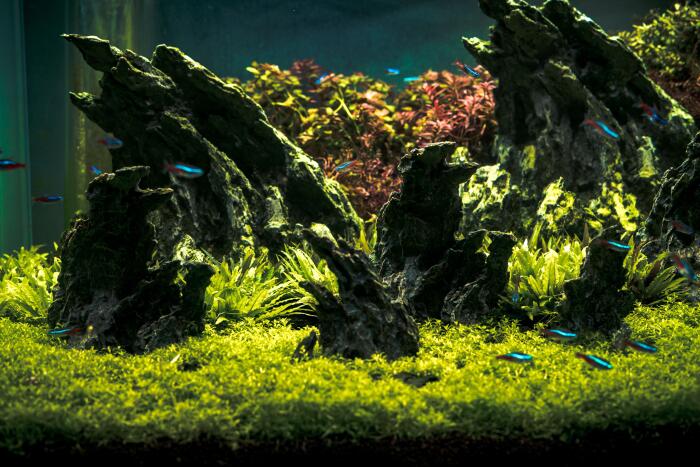
One of the most popular forms of aquascaping, nature aquariums do what they say–recreate nature within a planted aquarium. That said, they are nowhere near as precise or accurate as a biotope style aquascape. Nature aquariums aim to capture the spirit of nature in a small environment. So instead of creating an aquascape that could have been plucked right out of a natural environment, instead, a nature aquarium incorporates stones, driftwood, plants and other elements to create a composition that is reminiscent of many different natural scenes.
Nature aquariums create lovely vignettes that humans relish and delight in, while more naturalistic styles–like biotope–focus on what the fauna in the natural environment prefer. Plants used can include mosses, stem plants, carpeting plants and epiphytes, all within one cohesive scene. The goal is balance between various plants and materials and the proper layout is key to preventing the arrangement from becoming cluttered and the design from becoming disorganized and lost. AquaBed planting substrate pouches provide the perfect way to accommodate a wide range of plants and keep them looking healthy and robust with little to no maintenance.
Aquascaping Made Easy With AquaBed
Whether you’re new to aquascaping, already an old hand, or are asking yourself, “what is aquascaping?,” you can’t deny the beauty of planted aquariums. From hyperrealistic natural settings to more stylized and interpretive scenes, aquascaping offers a technique and approach for everyone. In fact, you might just come up with the next, new style, all on your own! This is a hobby and a passion that allows for plenty of self-expression, artistry, and originality. That said, if while growing your planted aquariums, you start to notice a decline and wonder “why are my aquarium plants turning yellow?,” trust that AquaBed can help!
AquaBed offers a nutrient-dense solution for planted aquariums that promote low-maintenance care, no matter the style you prefer. Our proprietary earth bed for aquascaping contains all the nutrients that plants in your planted aquarium need to thrive. From easy aquariums plants for beginners to more advanced selections, you can trust that our planting pouches will deliver balanced, high-quality nutrients without affecting water quality or fish health. Contact us with any questions, and get started with your own AquaBed today!